Showing posts with label Hundred Years War English. Show all posts

Tuesday, 26 September 2023

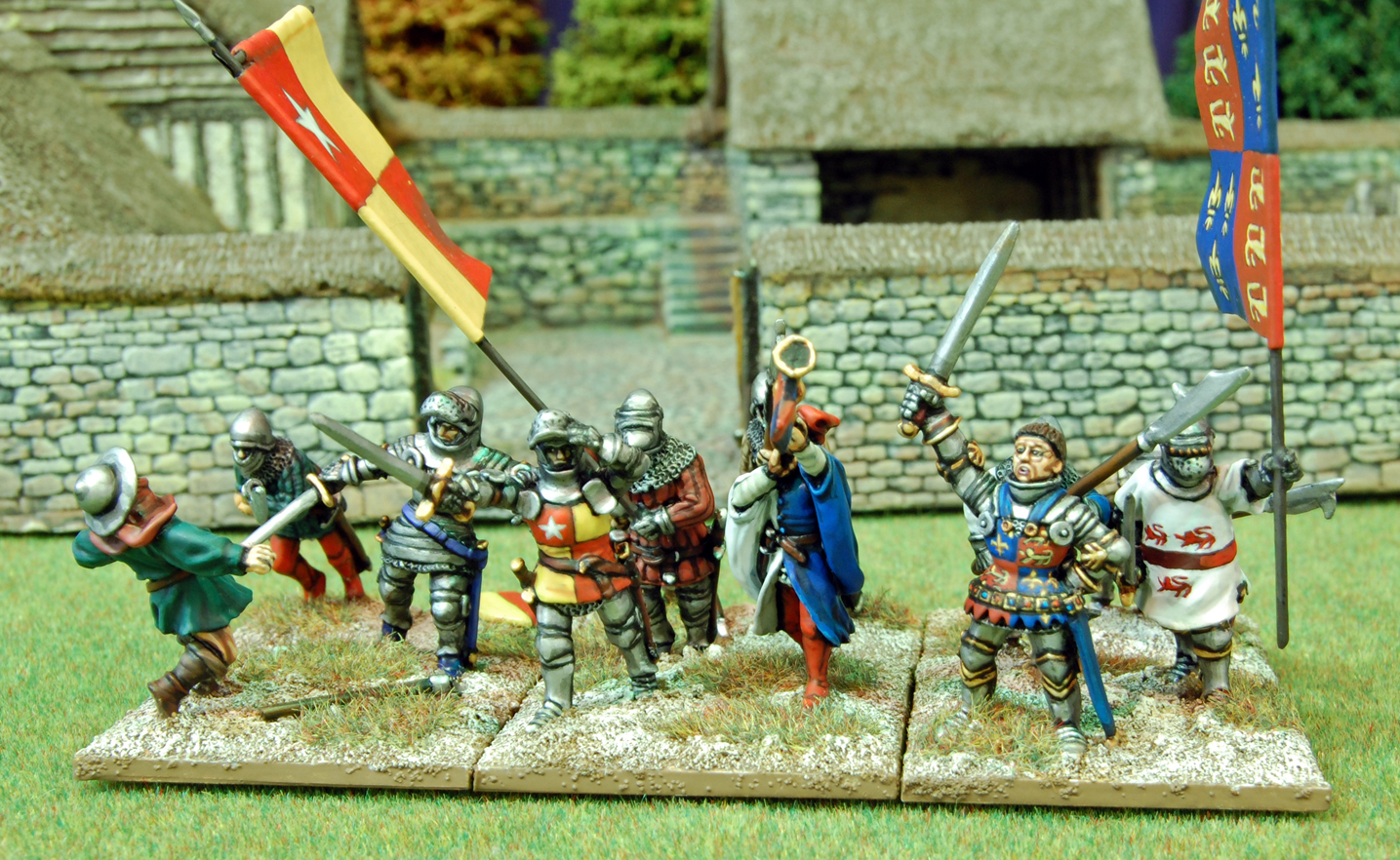
Agincourt 1415 Miniature Complete with Heraldry and Heraldic Banner

I'm obsessed about the Hundred Years War. I always have been since I was a child. I don't even know why! OK, as a wargamer I know why; I find it fascinating, alluring, and visually captivating.

I've been putting together a Warhammer Ancient Battles Hundred Years War English army from an army that has been rebased so many times it will not recover in terms of chips and damage. whilst not destroyed, I do want to make an effort to start again and Agincourt is just so iconic as a medieval battle, ergo the heraldic information much more accessible without combing tomes hidden in the deep dark vaults of the British Library, sadly unavailable to me. I hope to cover first, the Perry packs with the heraldry sculpted on as this will serve to give me a gauge as to just how large the charges etc need to be on the fields on the actual miniatures. I'm also endeavoring to paint up the heraldic banners too with both miniatures temporarily based. Eventually they will serve as the English battles at Agincourt! 

This will be done simultaneously as I crack on with my other projects so there's going to be plenty to see over the next few months/years.

"A Lancaster! A Lancaster! A Henry! A Henry!"


Saturday, 29 October 2022

Perry Hundred Years War Scenic Pictures SESWC 2011

Another blast from the past as revealed to me while I was messing about trying to delete as many pdf's and photo's from my Gmail account in order to avoid paying for storage!

This time some really nice pictures taken by my good friend, and at the time fellow SESWC club compatriot David Imrie way back in 2011, which was, I think, the same year the Perry's released their range(?).

And wonderful  it is to behold the pictures again; I was 100% convinced these pictures had died on an old laptop. 

All images are of course, "clickable"


Monday, 13 June 2022

Todd's Workshop/Tobias Capwell- Arrows vs Armour 2 - THE HELMET (fundraiser)

A very worthy cause for anyone interested in Late Medieval warfare, how just effective armours were against the English warbow and at a decent "average" draw weight; and perhaps more importantly, a draw weight which could be repeated .


Please follow the link for all the details on how you can support the project. At the time of typing it is fully funded but the more cash they have access to the more they can investigate this regularly debated topic.


Tuesday, 8 March 2022

More Hundred Years War Perry Goodness (Rescued from WaybackMachine)

I've been trawling through my old website again on the hunt for pictures that could be potentially be rescued from WaybackMachine. It is quite a frustrating process as more often then not the images most desirable for rescue will not link and I find myself just left with the thumbnails which are far too small to republish.

What we have here are photo's which were all part of my Agincourt project started immediately after Perry Miniatures began to produce their amazing Agincourt to Orleans range. All the bases were put together for a Warhammer Ancient Battles English army for the Hundred Years War supplement was being written by Alex Buchel of Saga fame. unfortunately GW close the book on WAB just prior to the publication of Alex's HYW supplement but we did get to enjoy a weekend with a taster of what we had missed at Games Workshop in Lenton on one of the WAB campaign weekends. For me, the miniatures for this range from the Dynamic Duo were just so dynamic, so full of action they screamed vignette style basing. To give you some idea of when the collection was started; the range, in metal, was certainly beginning to be released pre-2011 as I had already out much of the army together before moving back to England from Scotland in 2011. 

As I was saying, I made a real effort to set up each of the bases, which in WAB are supposed to be single miniatures based on a 20mm for Close Order or 25mm for Skirmishers/Light Infantry. This basing convention was excessively restrictive and not at all conducive to the vignette style basing I was aiming to produce. I wanted the miniatures to look as though they were in a fight; the high quality dynamic sculpts simply demanded it!

All the imaged are "clickable" though due to the manner in which the WaybackMachine links work, some are larger then others!

Here we have Henry V and his Heraldic Banner Bearer, Sir John Codrington along with the John de Vere, Earl of Oxford. They are based on a 120mm wide unit of three stands of 40mm x 40mm, two stands of 20mm x 40mm and two ordinary WAB bases of 20 x 20mm for ease of casualty removal. The miniatures were not bases in the usual WAB manner which would have been 6 in the first rank, six in the second and finally six in the rear rank, all on 20mm ox 20mm bases(!), which was way too regimented for my taste. The Hundred Years War is a period I dearly love, it brought me into wargaming and I wanted to do the units justice.


A couple of close ups of the above unit.


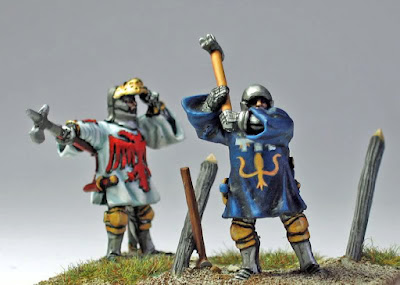
Here we have Sir Thomas Erpingham with his heraldic banner bearer still holding his famous baton as the archers gear up to the attack. The Stakes vignette at the front made use of the Perry Miniatures, AO5 Archers preparing for battle,hammering in and sharpening stakes pack. It was important to me to find a way to add some effusive energy as well as a feeling of real urgency to the unit and the PM AO5 pack was just the ticket. 


The Second longbow unit was set up as to have the archers in action as the French Men at Arms neared. I wanted the Archers to have that same feeling of urgency as in the former unit. In retrospect I think I over did this as lining up the Archers with some of the miniatures from the Perry Miniatures, AO6 Dismounted men at arms advancing into an arrow storm, produced a unit that was a little too sparse. 


I encountered the same problem with the final Archer unit (or maybe as Alex's HYW WAB event in Notts Approached I found myself running pout of painting time?) which is far too sparse for my taste nowadays. The thing to bear in mind is these were my first forays into vignette style basing and it was very much a learning process for me.


It would be remiss of me not to add my thanks to David Imrie for taking the scenic pictures above at SESWC, my opponent for that night for being patient while we set up the shots and finally to Barry Hilton of League of Augsburg fame for his brilliant Flodden bases, which are no longer in the Gallery on the LOA site but if you pop over to HERE, you will get an idea of how Barry's basing was to serve as inspiration to me.

More pictures dragged kicking and screaming from WaybackMachine:

Another shot of the first base of Longbowmen:


Of the "Stakes" vignette:


Close up of the Sir Thomas Erpingham Longbowmen Unit:


Archers in action unit:


Archers getting "Medieval on their asses" unit- right side, front:


As above but the left side, front of the base:


And again at eye level:


Close up:


Charles, Duke of Orléans and Jean II le Maingre, Marshal Boucicaut reaching the stakes and facing fierce resistance from the Archers. 


Archer nocking and fallen comrade:


And a few pics, again rescued from WaybackMachine of my army in the thick of it at Alex's Hundred Years War Campaign weekend in Notts many a moon back:


A Henry! A Henry! A Saint George!

Monday, 14 February 2022

Bedford's Battle, Battle of Verneuil 1424 Part II, Sir John Fastolf

What follows is a republication of a very old blog post (so old I cannot remember what year it was pit together- though mu guess would be 2010) recovered on Wayback Machine that I think Hundred Years War aficionados out there might find interesting. I chose to publish it again as it focuses in on the the John, Duke of Bedfore and the importance of pageantry and accompanying symbolism during the Hundred Years War. A subject that is often misunderstood and missing on the wargames table, at least in my opinion.

Now the turn of Sir John Fastolf

Sir John Fastolf, Knight Banneret. Here he is wearing his "cote amor", joining Bedford's in the rallying call as he thrusts forward his fist, egging his men forward after the archers had been all but routed and the battle looked to be lost. 

He carries his poleaxe in his right hand ready for the ensuing melee. Behind Fastolf a knight is in the process of finishing off one of the poorly armed and untrained French men at arms after jabbing him in the face with his cruel battle axe. Not all of the men at arms in the French contingent at Verneuil would have been so poorly armed and feebly trained but I felt compelled to include quite a few as a substantial number are likely to have been so bearing in mind the arriere ban had been enforced to put the army together. An unusual act on the [part of the "French" even during the dire circumstances that the 1430's demanded.


Sir John Fastolf was created knight banneret by Bedford and thus had the right to bear his heraldic banner. His banner bearer wears quite old fashioned armour in that he has a gambeson covering a coat of plates and little else by way of plate covering his torso. Nevertheless, the protection afforded by his armour would more then likely be adequate for the job at hand. Next him a man at arms is in full swing with his bill, often a dangerous manoeuvre during the press of combat, not only for himself as it leaves him open to a counter attack but for his friends too if too tightly pressed as is probable at Verneuil.


Bedford's Battle, Battle of Verneuil 1424 Part I, Bedford and Talbot

What follows is a republication of a very old blog post (so old I cannot remember what year it was pit together- though mu guess would be 2010) recovered on Wayback Machine that I think Hundred Years War aficionados out there might find interesting. I chose to publish it again as it focuses in on the the John, Duke of Bedfore and the importance of pageantry and accompanying symbolism during the Hundred Years War. A subject that is often misunderstood and missing on the wargames table, at least in my opinion.

Here we have Bedfords Battle for the WAB army that accompanied me to Havok! at Gripping Beast HQ, Evesham. (ED. Yep, that long ago!) The first unit I will be putting together for The Battle of Verneuil demo game will contain many of these miniatures, if not all of them. I think Simon and I have settled upon the idea of using Impetus, with some modifications, as it is probably for the good that we keep the rules simple as we are hoping to be chatting with a few folks as we play the game!

As the unit is based for WAB it gives me an opportunity to talk a little about the composition of the stands and what prompted me to paint up the miniatures in the manner that I have chosen. The mini's will be eventually be based for Impetus..... I'm thinking of 60mm by 60mm bases as this fits with other rule systems like Foundry's Medieval Warfare, and as many Medieval wargamers will know, it is not always easy to find a fellow enthusiast that plays the same rule system as one another. I will be adding another 60x60mm base in order to make the units 180mm wide as this will look much better on the tabletop and will make no difference whatsoever to the way in which the rules operate.


As you can see from the pics above featuring Bedford's stand, his heraldic attire is not in what you might expect from the third son of Henry IV and the uncle of Henry VI. As will be explained later, in an indepth introduction leading up to and including the battle, Bedford made a huge fuss of his personal Heraldic Pageantry prior to the Battle of Verneuil 1424 in a dramatic display designed to bring about strength through unity with the disparate forces he had available, from Normandy, from England and other parts of "English" France. To conjure up a sense of unity and purpose to the forces he had available. Prior to the battle Bedford was reported to be wearing a surcoat combining the white cross of France with the red cross of England in order to convey the the desired message of union between the two kingdom. Perhaps more importantly, as Regent of France for his nephew Henry VI, that he alone had the right to bear this coat of arms. I have painted him up with the white cross of France quartered with the red cross of England instead of superimposing the images as is suggested in de Waurin's account (you will hear more about this chap later). Bedford is a from Perry miniatures as are most of my collection. The actual mini is taken from their French High command at Agincourt on Foot pack and is the Duc de Orleans figure. His heraldry was beautifully sculpted on to the miniature by Michael Perry which in this case was actually an impediment to getting the effect I wanted! So, I took a Dremel to the heraldry (yep, you heard me! A Dremel) and carefully ground off his coat of arms. This was smoothed down by hand with a needle file before priming.

Next to John of Bedford stands John Talbot, known for his 
daring and martial prowess in battle. There is only one chronicle that indicates his presence at the battle (de Waurinbut I have included him as the rest of the 'cast of characters' were present and there is no reason to suppose that such an important figure would not be in amongst the action. Talbot wears his heraldic coat of arms and wields a poleaxe as appropriate to his rank and status.

The musician advancing behind Bedford and Talbot wears the Lancastrian livery of Bedford. Musicians of this type would have had a limited but important role on the battlefield, indicating where the banners were, at what pace to advance etc. It has to be said that once battle was joined they may have become superfluous during the clash of arms and din of battle.


This brings us onto the next base. Sir Henry Tilleman was given the right to bear Bedford's Heraldic banner. Tillemen was over 70 years old and had been active in the Black Prince's expedition to Spain and fought at the Battle of Najera, 1367! Bedford, by honouring Tillemen was making a deliberate link to the past and the Battle of Najera, which recalled the days of the Black Prince as a commander of renown enhancing the martial prowess of his army. Of the two other knights, one wears a surcoat and is evading a blow, perhaps as a feint, wielding his poleaxe. The other advances without bearing his arms as was often the practice of the English at that time.

Rebased for Impetus (now in the process of being rebased again!):


Sir John Fastolf is next :)