It is with some regret that I have had to cancel the game for Partizan on May 16th this year. Time that must be spent increasingly with the health issues of some the older members of my family which inevitably has encroached on the amount of time I could dedicate to producing the game. Family first.
As you might have noticed on social media I toyed for a few weeks with setting up a different skirmish based game, Aedric the Wild, Battle of Shrewsbury 1069, but in the end it felt like I was going to be putting on a second rate game and just did not sit right with me. I think the right decision has been made at the end of the day.
Apologies to all who wanted to see the game (I am making the assumption that there are a few of you out there?) and to the organisers especially Richard Tyndall who has offered to send me an invitation for Partizan II.
The good news is that the Reconquista game will continue to be worked on and will be on show as a display game in October the 11th and Partizan II.
Showing posts with label Battle of Sagrajas 1086. Show all posts
Showing posts with label Battle of Sagrajas 1086. Show all posts
Tuesday, 25 February 2020

Friday, 7 February 2020
Reconquista at Partizan, Yusef ibn Tashfin's Hasham Guard Cavalry
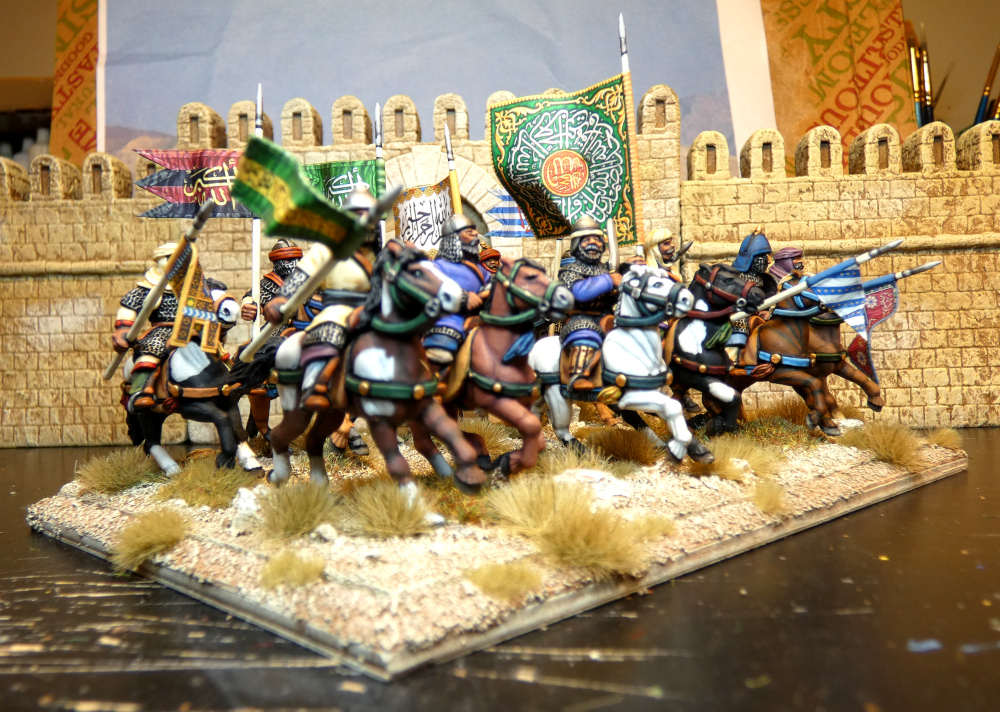
Finally, the completion of another cavalry unit! This time it is the turn of Yusef ibn Tashfin's Hasham Guard Cavalry Regiment.
Heavy Cavalry such as the Hasham Guard were something of a rarity among the Berber tribes thus it is likely that the guard units were specially raised and trained as personal bodyguards to the Emir, Shaykh or Sayyid. These units would not fight in the Christian style with their increasing tendency to couch the lance but rather with throwing spears and javelins albeit mounted on very sturdy horses. It is not clear as to whether the Hasham Guard units would use feigned flight as a tactic like many other Muslim cavalry types.
The cavalrymen are all Artizan Designs but the horses are all old Musketeer Miniatures (Now sold by Footsore Miniatures) as they have a superior look to them. The Footsore Miniatures are currently OOP but I have heard that they might be available again sometime this year- those that is not from the horses mouth (sorry :>) ). I was actually really surprised to see them OOP as I know Bill the sculptor reasonably well and I know that they were a range that was very close to his heart as they a his first sculpting passion of his. The prospect of having a Caliphate range available was one of his prime reasons for sculpting the range.
I have primarily used Vallejo paint but started with a Foundry Blue for the base of the miniatures cloaks, turbans and veils. The base for the Black is Andrea black which is wonderfully matt and a great base to start with when painting up a black robe. (It must be good as they have sold out of it in the Andrea online shop!) The protective layer of varnish is Humbrol Gloss Enamel with a final spray of Windsor and Newton Professional Matt Varnish to flatten things out. I find W&N to be the best matt varnish I have tried in all my years of painting (by a royal mile!).


Heavy Cavalry such as the Hasham Guard were something of a rarity among the Berber tribes thus it is likely that the guard units were specially raised and trained as personal bodyguards to the Emir, Shaykh or Sayyid. These units would not fight in the Christian style with their increasing tendency to couch the lance but rather with throwing spears and javelins albeit mounted on very sturdy horses. It is not clear as to whether the Hasham Guard units would use feigned flight as a tactic like many other Muslim cavalry types.
The cavalrymen are all Artizan Designs but the horses are all old Musketeer Miniatures (Now sold by Footsore Miniatures) as they have a superior look to them. The Footsore Miniatures are currently OOP but I have heard that they might be available again sometime this year- those that is not from the horses mouth (sorry :>) ). I was actually really surprised to see them OOP as I know Bill the sculptor reasonably well and I know that they were a range that was very close to his heart as they a his first sculpting passion of his. The prospect of having a Caliphate range available was one of his prime reasons for sculpting the range.
I have primarily used Vallejo paint but started with a Foundry Blue for the base of the miniatures cloaks, turbans and veils. The base for the Black is Andrea black which is wonderfully matt and a great base to start with when painting up a black robe. (It must be good as they have sold out of it in the Andrea online shop!) The protective layer of varnish is Humbrol Gloss Enamel with a final spray of Windsor and Newton Professional Matt Varnish to flatten things out. I find W&N to be the best matt varnish I have tried in all my years of painting (by a royal mile!).


Saturday, 25 January 2020
Reconquista at Partizan 2020, Shield Tassels and Remodelling Spears
Just a quickie today.....
As well as getting on with the brushwork on the Mounted Hasham Guard I've been doing a little work every day on adding shield tassels made easily from Greenstuff and repositioning the hands of the Artizan models that will be making up the Sudanese Guard unit. As I've explained before the natural angle of most of hands on the Artizan Designs 'Moors' are angles in such a way as to make it look very unnatural once the spear is placed in the hand. So, I have gently cut the hands off the models with a razor saw and then pinned them back into position at a more natural angle.
These miniatures are ready for priming. I use Vallejo black spray primer for a couple of reasons. Firstly even if it begins to pool this soon evaporates leaving all but a solid thin layer that acts as a key for further paint. Second, I have in the past experimented with using grey primer and even white but I'm so used to working with a black 'undercoat' that it is really just the habit of being able to leave a little black showing through the base layers that makes a model 'pop'.

As well as getting on with the brushwork on the Mounted Hasham Guard I've been doing a little work every day on adding shield tassels made easily from Greenstuff and repositioning the hands of the Artizan models that will be making up the Sudanese Guard unit. As I've explained before the natural angle of most of hands on the Artizan Designs 'Moors' are angles in such a way as to make it look very unnatural once the spear is placed in the hand. So, I have gently cut the hands off the models with a razor saw and then pinned them back into position at a more natural angle.
These miniatures are ready for priming. I use Vallejo black spray primer for a couple of reasons. Firstly even if it begins to pool this soon evaporates leaving all but a solid thin layer that acts as a key for further paint. Second, I have in the past experimented with using grey primer and even white but I'm so used to working with a black 'undercoat' that it is really just the habit of being able to leave a little black showing through the base layers that makes a model 'pop'.

Thursday, 23 January 2020
Reconquista at Partizan 2020, Yusuf ibn Tashfin Command Base

Yusef ibn Tashfin victor against Alfonso Vi of Leon and Castile was a very remarkable man. As leader of the Moroccan Almoravid dynasty and was one of the founders of the city of Marrakesh. On heading the call of the Taifa Kingdoms, the once mighty kingdom of Al Andalus in Southern Spain; pleading for military aid and intervention in order to block the encroachment of the resurgent Christian Kingdoms. Tashfin managed to unite the Taifa Kingdoms with his Almoravid invasion force and lead a very successful campaign, putting the Christian forces under immense pressure and devastating the ambitions of Alfoso.

He faced Alfonso VI of Leon and Castile twice in open battle winning spectacular victories on both occasions at the Battle of Sagrajas 1086 and the Battle of Consuegra 1097 respectively.

This piece is the command base that will be attached to the Yusef ibn Tashfin's Black Guard. His personal guard and chosen mostly from Slav and Sudanese slaves.

Tuesday, 21 January 2020
The Wringing of Hands
One of the units I'm prepping the another belonging to Yufes ibn Tashfin's army. These being Sudanese spearmen using Artizan's Arfican Spearmen from the 'Moors' range. One thing I noticed with some dismay when painting up the Black Guard unit was the very annoying habit of the Artizan miniatures holding their spears angled about 45 degrees to the right side. This made it quite painful at times to base the Black Guard unit as the spears tended to be pointing at the exact space where I would have ideally liked to place the next mini! I had no such problem with the Saxon Miniatures Black Guard (now sold by Warlord) where the spears were perfectly positioned.
My solution? I have carefully cut the hands off a quarter the miniatures, allowing some to still have the angle for variation, filed the arms to get a nice soft edge then pinned the hands back on! It is a bit of a pain but the end results are worth it.
Here's a quick snap to illustrate what I mean. The figure on the left has the hand in it's original position, the three figures to the right have all had the hands removed and pinned.

Just another 12 to go. The rest of the unit being made up of Gripping Beast Nubian Spearmen in Padded Coats
My solution? I have carefully cut the hands off a quarter the miniatures, allowing some to still have the angle for variation, filed the arms to get a nice soft edge then pinned the hands back on! It is a bit of a pain but the end results are worth it.
Here's a quick snap to illustrate what I mean. The figure on the left has the hand in it's original position, the three figures to the right have all had the hands removed and pinned.

Just another 12 to go. The rest of the unit being made up of Gripping Beast Nubian Spearmen in Padded Coats
Friday, 17 January 2020
Reconquista at Partizan 2020, Andalusian Noble Cavalry
Things have been a bit stressful of late with various close relatives in and out of hospital but I have managed squeeze in the time to get quite a lot of painting done! I'm not sure where I found the mental resources let alone the time but it has been managed!
I have delayed posting these pics as I had entered The Analogue Hobbies Painting Challenge and the rules state I must wait one day before I can publish anything I have entered on my Blog- which is fair enough of course. I was drawn to the Painting Challenge as a means to keep the impetus going to get the right units painted up for the Partizan show on May 17th of this year. It's a tall undertaking but I am armed with enthusiasm, a love of painting miniatures and with the added impetus of the Painting Challenge all should be well.
A word in regarding the planned Partizan game. Nothing is written in stone yet but I feel myself moving away from what I had originally planned, that being the Battle of Sagrajas 1086, to that of the Battle of Consuegra 1097 which followed a siege of the town by the same name. This will allow for city walls to be introduced to the tabletop which will add two important factors; as well as a historical 'flash back' at the preliminaries prior to the battle, it will serve as a nice focal point and help counterbalance out the masses of miniatures with a large section that is all terrain and scenery. In fact I have the city walls on order and will be picking them up at Vapnartak on February 2nd!
Back to the subject at hand! Andalusian horses were famous throughout Europe for being of the finest quality and were often bread with other breeds in North Western Europe to produce warhorses. Whilst being strongly built, they were compact yet elegant creatures. These steeds were ridden into battle by Andalusian Nobles and lesser men alike.


I have delayed posting these pics as I had entered The Analogue Hobbies Painting Challenge and the rules state I must wait one day before I can publish anything I have entered on my Blog- which is fair enough of course. I was drawn to the Painting Challenge as a means to keep the impetus going to get the right units painted up for the Partizan show on May 17th of this year. It's a tall undertaking but I am armed with enthusiasm, a love of painting miniatures and with the added impetus of the Painting Challenge all should be well.
A word in regarding the planned Partizan game. Nothing is written in stone yet but I feel myself moving away from what I had originally planned, that being the Battle of Sagrajas 1086, to that of the Battle of Consuegra 1097 which followed a siege of the town by the same name. This will allow for city walls to be introduced to the tabletop which will add two important factors; as well as a historical 'flash back' at the preliminaries prior to the battle, it will serve as a nice focal point and help counterbalance out the masses of miniatures with a large section that is all terrain and scenery. In fact I have the city walls on order and will be picking them up at Vapnartak on February 2nd!
Back to the subject at hand! Andalusian horses were famous throughout Europe for being of the finest quality and were often bread with other breeds in North Western Europe to produce warhorses. Whilst being strongly built, they were compact yet elegant creatures. These steeds were ridden into battle by Andalusian Nobles and lesser men alike.
I decided to move away from the dark I used on colours of the unit of Yusef ibn Tashfin's Black Guard and to go for it with a colour scheme on each mini with both complimentary and contrasting colours. Due to the limited time I have to prepare for the game I was not able to be as lavish as I would have liked, for example, no complicated patterns of the hems of the clothing, no patterns on the silks gowns. This is something that sits easily with me as the unit looks good enough in my opinion. It is not my best work but for the purposes of the game, given that one looks at a game from a metre or so away, it is detailed enough.
I went with a uniform shield colour and pattern to visually pull the unit together using neutral grey as to avoid any 'violent' colour clashes that might otherwise have occurred.


Monday, 6 January 2020
Sagrajas 1086; Yusuf ibn Tashfin's Black Guard
I've just taken delivery of a new camera so it seemed appropriate to take some pictures of the initial units for Sagrajas 1086, starting with Yusuf ibn Tashfin's Black Guard. I have yet to work my way around the camera so I just put everything on automatic and pointed the lens! Looking at the pictures I could have arranged the lighting a little better and no doubt the photography course I'm enrolled on will allow me to work through the details of how to get the best results sooner rather then later.
The unit is that of Yusuf ibn Tashfin's Black Guard which stood in reserve for quite a while at Sagrajas. I've yet to do the command stand as I've been busy with two cavalry units, one Andalusian 'heavy' and one Hashim Guard 'heavy' along with a unit of 'Arab' horse archers (they will be 'arabised' Ghuzz or Turcoman).
There's a very interesting if brief article on Wiki about the origins of the Moroccan Royal Guard and their oprigins with Yusef ibn Tashfin's Black Guard HERE.
I stuck the Tablescape Designs Indian fortress walls in the background as to avoid a large number of paint pots cluttering up the images!


Friday, 20 December 2019
The Analogue Hobbies Painting Challenge
In order to give a little more impetus to my Sagrajas 1086 project which has to be ready by May 17th next year for Partizan in Newark I'm going to be entering the The Analogue Hobbies Painting Challenge. This will no doubt enable me to keep a better tally on what needs to be painted up and be a little more efficient about the process.
Did I mention it would be fun too? No doubt..... :>)
If you aren't aware of what the The Analogue Hobbies Painting Challenge is all about then I highly recommend that you shoot over to the site in the links above and check it out. There are some lovely examples of painting that has been done over the years on display.
Did I mention it would be fun too? No doubt..... :>)
If you aren't aware of what the The Analogue Hobbies Painting Challenge is all about then I highly recommend that you shoot over to the site in the links above and check it out. There are some lovely examples of painting that has been done over the years on display.
Thursday, 12 December 2019
Battle of Sagrajas 1086
Battle of Sagrajas 1086: Prelude:
(Firstly, let me apologise about how some of the text of my article has come out on Blogger! I'm currently trying to remedy it though it seems I cannot find a background for the text that matches that of my Blog!)
What follows is what I have managed to glean thus far on the build up to and the fighting at the Battle of Sagrajas 1086. It is by no means a comprehensive view of the battle and I'm sure more I read, the more I will learn and the more my knowledge of the battle will grow. It needs to be said that the historical sources are customarily scarce in reference Sagrajas as is the case with most Medieval battles of this time period. I'm trying not to view this as a negative, but rather a positive as it will allow for the creation of some nice vignettes as well as allowing me to ad lib a little on the composition of part of the forces and terrain.
Toward the last decades of the 11th century forces of Christian Spain and Portugal started to make major inroads into central 'Muslim' southern Spain. This was precipitated by the dissolution of The Independent Umayyid Emirate of Cordoba (929-1031) and the dismemberment of the state into the first petty Taifa Kingdoms (1031-1091). Such a disjuncture was to severely weaken Islamic military strength in Spain and many of the Taifa 'Kings' were forced to pay (literally) extortionate sums of money in tribute to the Christian Kingdoms to the North draining them of not only wealth but diminishing the ability of these small states to pay the costs of their own defence.
The Christian forces were drawn not just from King Alfonso VI of Leon-Castile vassals and general levy but a force of Mercenaries were gathered under Alvar Fanez who was recalled from Valencia along with many individual knights from parts of Christendom but mainly from Italy and France.
King Alfonso VI of Leon-Castile's capture of the Muslim city of Toledo sparked a degree of panic among the Taifa Kingdoms sufficient enough to instigate a series of appeals for military assistance to the Berber tribes of North Africa; The Almoravid Empire. The Almorivid leader, Yusuf ibn Tashufin (Arabic: يوسف بن تاشفين ناصر الدين بن تالاكاكين الصنهاجي)) headed the call and moved his army from Algeciras to the port of Badajoz in Castile where Yusef's ranks were swollen by al Mu'tamid and contingents from Grenada, Seville and Malaga.
As is the norm the numbers involved are speculative; medieval historians being notorious for exaggerating numbers when referencing battles. A possible acceptable estimate would be to say that the Muslim army probably outnumbered the Christian forces. Though there are no precise numbers of men involved in the fighting it is probable the Muslim host contained approximately 7,000 horsemen and a large number of infantry (Christians and the Moors in Spain) and the Christian force smaller than that of their enemy. I am going to put the numbers of Christian Knights and Lesser Knights (Caballeros Villanos) at about 5000 to 6000 with a number of infantry of varying quality.
Alfonso VI, initially besieging the City of Saragossa, on hearing of the congregation of the Muslim forces at Badajoz abandoned the siege, declared a 'fossata' (matching the meaning of the French word 'chevauchee': 'ride'), summoned more of his vassals enhancing his forces already at hand from Leon and Castile with the addition of men mercenaries commanded by Alvar Fanez with his additional some troops from Italy and France.
After a year of small scale raids and much preparation the two armies were to meet at Sagrajas on the 20th of October 1086.

Battle of Sagrajas 1086: The Battle:
The Christian camp was located north of the River Genorva (a tributary of the River Guadiana) whilst the Muslim armies camp was located next to the confluence of the River Guardiana.
For three days the two sides sat, watching one another warily across the River Guadiana, each observing the tactical and military capabilities of their enemies whilst heralds from both camps negotiated. The negotiations are likely to have been more of an attempt to calculate the military strength and capabilities of their opponents than to have been a serious attempt to negotiate a peace. Finally prior to dawn on Friday 23rd of October, being a Muslim Sabbath day, probably hoping to take Yuseh ibn Tashufin's army by surprise the Christian host moved over the River Guadiana and attacked with the knights to the fore, lighter cavalry in the rear followed in turn by the infantry.
The Christian Heavy Cavalry force lead by Alvar Fanez were the first to strike the Muslim lines hitting the Taifa/Andalusian cavalry force, put to the fore by Yusuf ibn Tashufin who seemingly had little confidence with the native Muslim troops of the Tiafa kingdoms of Southern Spain. His was assumption seemed to be justified as after a brief fight, the Taifa Cavalry was put to flight heading south towards Yusuf ibn Tashufin main army and camp. It appears that Alvar Fanez's force caught up with the fleeing Andalusian Cavalry and another fight occurred to the fore of the Almoravid Camp where the Andalusians were again put to flight by the knights. As this was happening the Almoravid Infantry desperately form up to formed a battle line in front of their camp.
Meanwhile Alvar Fanez's force of knights were reinforced by a second wave of fresh knights under King Alfonso VI. Both contingents were to meet the Almorivid Infanry head on. The disciplined Almoravid medium/heavy cavalry sheltered in the Alcazaba hills on Yusuf ibn Tashufin left flank charged into the fray hitting King Alfonso VI's force in the flank. Part of the Christian force is driven back, a bloody fight ensuing as the part of the Christian force is pushed back to their own camp. A total disaster for King Alfonso VI army!
In the frenzy of hand to hand fighting Alfonso VI was wounded whilst at the same time the Almoravid cavalry that head now reached the Christian camp attacked it but are repulsed by the infantry guarding Alfonso's encampment. The rest of the Christian army flees from the melee and is pursued by the Almoravid army. The pursuit however, was not followed up allowing for what was left of Alfonso VI's army to retire to Coria.
In my next post for Sagrajas I will be laying out my plans as to how I am going to re fight the battle. I will have to make some alterations, for example, I want to include some Christian infantry in support of Alfonso VI's mainly cavalry force. A sort of "what if?", if you like. On the other hand, details of the battle are so scarce that a "what if?" is more than appropriate!

The Christian Heavy Cavalry force lead by Alvar Fanez were the first to strike the Muslim lines hitting the Taifa/Andalusian cavalry force, put to the fore by Yusuf ibn Tashufin who seemingly had little confidence with the native Muslim troops of the Tiafa kingdoms of Southern Spain. His was assumption seemed to be justified as after a brief fight, the Taifa Cavalry was put to flight heading south towards Yusuf ibn Tashufin main army and camp. It appears that Alvar Fanez's force caught up with the fleeing Andalusian Cavalry and another fight occurred to the fore of the Almoravid Camp where the Andalusians were again put to flight by the knights. As this was happening the Almoravid Infantry desperately form up to formed a battle line in front of their camp.
Meanwhile Alvar Fanez's force of knights were reinforced by a second wave of fresh knights under King Alfonso VI. Both contingents were to meet the Almorivid Infanry head on. The disciplined Almoravid medium/heavy cavalry sheltered in the Alcazaba hills on Yusuf ibn Tashufin left flank charged into the fray hitting King Alfonso VI's force in the flank. Part of the Christian force is driven back, a bloody fight ensuing as the part of the Christian force is pushed back to their own camp. A total disaster for King Alfonso VI army!
In the frenzy of hand to hand fighting Alfonso VI was wounded whilst at the same time the Almoravid cavalry that head now reached the Christian camp attacked it but are repulsed by the infantry guarding Alfonso's encampment. The rest of the Christian army flees from the melee and is pursued by the Almoravid army. The pursuit however, was not followed up allowing for what was left of Alfonso VI's army to retire to Coria.
In my next post for Sagrajas I will be laying out my plans as to how I am going to re fight the battle. I will have to make some alterations, for example, I want to include some Christian infantry in support of Alfonso VI's mainly cavalry force. A sort of "what if?", if you like. On the other hand, details of the battle are so scarce that a "what if?" is more than appropriate!

Map Below (Taken from Erenow; Military History Site LINK):
"(a) Phase I: After three days of mutual
observation by the two armies, the Christian forces, organized into
two waves, launch an attack across the Guadiana River (1). Alvar
Fanez’s Aragonese mercenaries strike al-Mu’tamid’s Moors in the
first Muslim line (2). The Andalusians’ formations are broken, with
the exception of the Sevillians under al-Mu’tamid himself, and flee
towards the Muslim stronghold at Badajoz (3). (b) Phase II: Fanez and
his Aragonese cavalry set off in pursuit of the Moors fleeing towards
Badajoz (1). King Alfonso orders his larger Spanish contingent to
charge the Almoravid line beyond the protective ditch (2). As the
Muslim line gives way (3) and Alfonso presses on to the Berber camp
(4), Yusuf orders his reserves into action using drum signals. Abu
Bakr leads a division of Moroccans into action to assist al-Mu’tamid
(5), while Yusuf sweeps past the Christians’ unprotected flank to
fall on Alfonso’s camp (6). (c) Phase III: Learning of the attack
on his camp, Alfonso hastily confers with his subordinate commanders
and orders a return to the Christian camp (1). The Spanish forces
suffer heavy casualties fighting their way back (2) but succeed in
reaching their camp where they form a new line (3). As Alfonso
organizes his surviving knights into a defensive line, Fanez returns
from his pursuit (4), only to abandon the king after quickly
assessing the grim situation (5). (d) Phase IV: Emboldened by the
defection of Fanez’s mercenaries, the now reinforced Moorish forces
from the first line launch a counter-attack (1). The Muslim forces
are soon joined by some of the Andalusians that had earlier fled
towards Badajoz in an apparent karr-wa-farr (2). The situation grows
increasingly desperate for Alfonso. As night approaches, Yusuf spots
a gap in the Spanish line (3) and orders in his elite ‘Black Guard’
(4). Alfonso is wounded, but the king’s bodyguard rallies and
carries him out of the fray to the safety of a nearby hill (5). The
Muslim forces sack the Christian camp as the king and some 500
survivors manage to escape the scene of their defeat under cover of
darkness.With
the majority of the Moorish line routing, King Alfonso ordered the
second, larger Spanish force into action (Map 3.9(b)). These
better-armed and more heavily armoured Christian cavalry pushed
through the remnants of the first Muslim formation and hit the second
Almoravid line, smashing the Berber front, then crossed the ditch to
strike the Berber camp beyond. At this moment, Yusuf ordered most of
his reserves into the fray, orchestrated by drumbeats. A division of
Moroccan tribesmen under the command of Yusuf’s lieutenant Abu Bakr
reinforced al-Mu’tamid, while Yusuf himself swept around the
Christian flank and fell on Alfonso’s camp. When the king of
Castile-Leon learned of this attack on his rear, he held a hasty war
council and decided to remove himself from his precarious position
(Map 3.9(c)). Despite heavy casualties, the Spanish knights fought
their way back to their camp and formed a new line."
Wednesday, 13 November 2019
Yusuf ibn Tashfin's Black Guard Beginning to Take Shape
I'm pleased to announce that I have finished painting and the first 12 (Gulp! A long way to go as of yet!!) miniatures of Yusuf ibn Tashfin's Black Guard have been rolled out. I went for quite a plain black colour scheme highlighted by a deep blue as I wanted the Black Guard to look quite menacing on the tabletop.
I've went for a mix of Artizan Designs, Footsore (actually Musketeer) and Saxon Miniatures (now sold by Warlord Games). In the main these will be the manufacturers of choice but with the (obvious!) addition of Gripping beast, Doyens of the Dark Ages, superb "El Cid" range. The miniatures have been blue tacked into position on the bases as I want the composition to be flexible should I change my mind about positioning as more figures are added.
I've gone more for a sort of Sudanese look with darker skin tones than I plan to paint the 'Berber' and Andalusian units in the army. I'm not sure I'm 100% happy with the paint scheme on the Black Guard but considering I have not done any painting for roughly five years I should probably not be so harsh on myself. Ohmmmmm..... just breathe!

Having recently done some research on the hippo shields carried by many 'Berber' tribes what I discovered was quite interesting. The existing examples of hippopotamus hide shields in various collections and museums around the globe show signs that the shield significantly blackened as the object aged. I've gone for a much lighter 'brown' and have layered the paint in such a way as to suggest the ridges that occurred during construction that one tends to find on the surviving examples. My lighter shields are not realistic in tone. The brown is matched to be reasonably complimentary to the blue in order to create some degree of colour balance. You can't take the fine art college education out of the man- apparently!
Ethiopian Hippo Hide Shield
(slightly 'blackened' with age)

Beja Shield from the 19th Century

Here are a couple of quick snaps of the unit as it takes shape from the right and the left which should give some idea of the dynamic that I am hoping to create; that of a unit in combat and not the static unit of spearmen one sometimes finds in armies of the period. I want all my units to have some sort of vignette as a minor focal point but also to show that this is a fighting force. This has always been a theme in all of my armies including my old WAB armies! Not so easy to to with a one mini- one base type of army as one found in most WAB armies.
For the spears I've gone with a cane type affair as exemplified in the El Cid WAB Supplement written by James Morris. They are referred to as bamboo in the El Cid book but as someone on LAF pointed out in my first post covering this game, it is unlikely to have been bamboo as the materiel would have had to travel several thousands of miles if that were so! If you are interested in the Spanish Reconquista and you have not got a copy of this great book then I suggest that you try your utmost to get a copy! It's filled with a wealth of information, ideas and general military history. Really. It's a gem of a book. As Warhammer historical are no longer with us you will have to look online to buy a copy. I'm sure there will be plenty of them floating about if you look in the right places. The Wanted section of the Bazaar in the Lead Adventure Forum would be a great place to start.


As you will no doubt have noticed the miniatures need another coat of matte varnish as a few bits were missed after giving them the coat of gloss. This is inevitable when varnishing with a Matte Spray over a first layer of gloss as when you apply the varnish the matte looks as glossy as the gloss! Fun, fun, fun! The gloss I'm currently using is Humbrol Enamel Varnish Spray. This is not typical as I would normally have given the miniatures a brush on coat of Humbrol Gloss thinned with a little white spirit. I find that this gives a much tougher coat then the gloss spray and it also allows for better control of any 'pooling'. Unfortunately, I cannot find my tin of brush on Humbrol Gloss at present but I'm certain that it is safe and sound in the many boxes that I put my painting gear in! One of the fun parts of packing everything away and unpacking..... not!


This was intended to be a quick post. Not only to show that the armies were beginning to take shape but somehow to give me some impetus into getting stuck into getting the units modelled and painted.
Subscribe to:
Posts (Atom)