Showing posts with label Battle of Verneuil 1424. Show all posts

Monday, 14 February 2022

Bedford's Battle, Battle of Verneuil 1424 Part II, Sir John Fastolf

What follows is a republication of a very old blog post (so old I cannot remember what year it was pit together- though mu guess would be 2010) recovered on Wayback Machine that I think Hundred Years War aficionados out there might find interesting. I chose to publish it again as it focuses in on the the John, Duke of Bedfore and the importance of pageantry and accompanying symbolism during the Hundred Years War. A subject that is often misunderstood and missing on the wargames table, at least in my opinion.

Now the turn of Sir John Fastolf

Sir John Fastolf, Knight Banneret. Here he is wearing his "cote amor", joining Bedford's in the rallying call as he thrusts forward his fist, egging his men forward after the archers had been all but routed and the battle looked to be lost. 

He carries his poleaxe in his right hand ready for the ensuing melee. Behind Fastolf a knight is in the process of finishing off one of the poorly armed and untrained French men at arms after jabbing him in the face with his cruel battle axe. Not all of the men at arms in the French contingent at Verneuil would have been so poorly armed and feebly trained but I felt compelled to include quite a few as a substantial number are likely to have been so bearing in mind the arriere ban had been enforced to put the army together. An unusual act on the [part of the "French" even during the dire circumstances that the 1430's demanded.


Sir John Fastolf was created knight banneret by Bedford and thus had the right to bear his heraldic banner. His banner bearer wears quite old fashioned armour in that he has a gambeson covering a coat of plates and little else by way of plate covering his torso. Nevertheless, the protection afforded by his armour would more then likely be adequate for the job at hand. Next him a man at arms is in full swing with his bill, often a dangerous manoeuvre during the press of combat, not only for himself as it leaves him open to a counter attack but for his friends too if too tightly pressed as is probable at Verneuil.


Bedford's Battle, Battle of Verneuil 1424 Part I, Bedford and Talbot

What follows is a republication of a very old blog post (so old I cannot remember what year it was pit together- though mu guess would be 2010) recovered on Wayback Machine that I think Hundred Years War aficionados out there might find interesting. I chose to publish it again as it focuses in on the the John, Duke of Bedfore and the importance of pageantry and accompanying symbolism during the Hundred Years War. A subject that is often misunderstood and missing on the wargames table, at least in my opinion.

Here we have Bedfords Battle for the WAB army that accompanied me to Havok! at Gripping Beast HQ, Evesham. (ED. Yep, that long ago!) The first unit I will be putting together for The Battle of Verneuil demo game will contain many of these miniatures, if not all of them. I think Simon and I have settled upon the idea of using Impetus, with some modifications, as it is probably for the good that we keep the rules simple as we are hoping to be chatting with a few folks as we play the game!

As the unit is based for WAB it gives me an opportunity to talk a little about the composition of the stands and what prompted me to paint up the miniatures in the manner that I have chosen. The mini's will be eventually be based for Impetus..... I'm thinking of 60mm by 60mm bases as this fits with other rule systems like Foundry's Medieval Warfare, and as many Medieval wargamers will know, it is not always easy to find a fellow enthusiast that plays the same rule system as one another. I will be adding another 60x60mm base in order to make the units 180mm wide as this will look much better on the tabletop and will make no difference whatsoever to the way in which the rules operate.


As you can see from the pics above featuring Bedford's stand, his heraldic attire is not in what you might expect from the third son of Henry IV and the uncle of Henry VI. As will be explained later, in an indepth introduction leading up to and including the battle, Bedford made a huge fuss of his personal Heraldic Pageantry prior to the Battle of Verneuil 1424 in a dramatic display designed to bring about strength through unity with the disparate forces he had available, from Normandy, from England and other parts of "English" France. To conjure up a sense of unity and purpose to the forces he had available. Prior to the battle Bedford was reported to be wearing a surcoat combining the white cross of France with the red cross of England in order to convey the the desired message of union between the two kingdom. Perhaps more importantly, as Regent of France for his nephew Henry VI, that he alone had the right to bear this coat of arms. I have painted him up with the white cross of France quartered with the red cross of England instead of superimposing the images as is suggested in de Waurin's account (you will hear more about this chap later). Bedford is a from Perry miniatures as are most of my collection. The actual mini is taken from their French High command at Agincourt on Foot pack and is the Duc de Orleans figure. His heraldry was beautifully sculpted on to the miniature by Michael Perry which in this case was actually an impediment to getting the effect I wanted! So, I took a Dremel to the heraldry (yep, you heard me! A Dremel) and carefully ground off his coat of arms. This was smoothed down by hand with a needle file before priming.

Next to John of Bedford stands John Talbot, known for his 
daring and martial prowess in battle. There is only one chronicle that indicates his presence at the battle (de Waurinbut I have included him as the rest of the 'cast of characters' were present and there is no reason to suppose that such an important figure would not be in amongst the action. Talbot wears his heraldic coat of arms and wields a poleaxe as appropriate to his rank and status.

The musician advancing behind Bedford and Talbot wears the Lancastrian livery of Bedford. Musicians of this type would have had a limited but important role on the battlefield, indicating where the banners were, at what pace to advance etc. It has to be said that once battle was joined they may have become superfluous during the clash of arms and din of battle.


This brings us onto the next base. Sir Henry Tilleman was given the right to bear Bedford's Heraldic banner. Tillemen was over 70 years old and had been active in the Black Prince's expedition to Spain and fought at the Battle of Najera, 1367! Bedford, by honouring Tillemen was making a deliberate link to the past and the Battle of Najera, which recalled the days of the Black Prince as a commander of renown enhancing the martial prowess of his army. Of the two other knights, one wears a surcoat and is evading a blow, perhaps as a feint, wielding his poleaxe. The other advances without bearing his arms as was often the practice of the English at that time.

Rebased for Impetus (now in the process of being rebased again!):


Sir John Fastolf is next :)

Thursday, 20 February 2020

More Battle of Verneuil Salute 2011 Pictures (From La Journee Blog)

Credit for these pics and the former must go to Joe Dever, Phil Steele and Ray. without the generosity of these gents I wouldn't have anything to show for our efforts and this blog would be a less happy place. Lesson learnt- always check your camera for the battery before you leave for a show!

Thanks again guys- hugely appreciated given that I forgot the battery for my camera on the day lol


Wednesday, 19 February 2020

Salute 2011 and The Battle of Verneuil Demo Game (From La Journee Blog)

From La Journey Blog 2011.

At the risk of blowing my own trumpet (well Simon Chick's really as most of the mini's and all of the terrain were his) I think in many ways the Verneuil game Simon and I put on way back in 2011 set the tone for the requisite quality of massed battle Late Medieval games. It even made it into the Wargames Illustrated "Great Wargames" Special. An honour.

OK, picture the scene; terrain all set up- check. Mini's all set out- check. Sets tripod up and get's camera out of case- check. Fixes camera to tripod and switches on- check. Nothing happens!! Takes camera off tripod and thinks "this feels a little light"! Remembers! Battery is recharging in Durham!! The lack of photo's to post being the reason that this battle report covering our demo game at Salute is so late.

It was all a bit of a coup really as all the organising was done via the internet and one Skype conference call! Madness? Maybe, but we pulled it off in the end :O)

The decision was made in the early stages of the games' metamorphosis our version of the battle would be based on Mike Jones' academic paper, Michael K Jones essay The Battle of Verneuil (17th August 1424): Towards a History of Courage. The Lombard and French mounted men at arms were to form a line at the fore of the French battles instead of the starting on the flanks thus launching their attack as soon as the opening shots of the battle started and head straight at the English centre- see earlier post here details.

We had four players, Simon Chick took Salisbury's battle, Nigel Cook Bedfords, whilst the Franco-Scottish were played by George Moriatis as the French and Lombard mounted men at arms and the French Left and Nick Palmer the Scots.


As hostilities opened the Lombards and their French comrades came charging across the battlefield surprising the English and hitting them hard in the centre. The English centre looked hard pressed as the Lombards heavily harnessed mounts ploughed into the English men at arms and archers. For a moment or two it looked for all intents and purposes that the tabletop reenactment was about to take the same turn as the battle proper! However, following some fluky dice rolling the English were saved- or Bedford rallied the English troops exorting his men to fight on! As the game wore on the French and Scottish missile troops made their ponderous way forward followed by the bulk of their dismounted melee troops. It was at this point with things beginning to look very grim for the English- the table we had been given was not wide enough for us to deploy all of our terrain tiles and there was to be no room for the English reserves to make an appearance around a flank! Something we will certainly remedy when we show the game again! All things considered, in a turn or two poor Bedford was going to lose more than his worldly possessions.....

And the rest of Salute? OK, as for buys, well, I continued my quest for Ancient/Medieval rules and bought Hail Ceasar from Warlord Games and was kindly given a copy of Clash of Empires by Stuart of Great Escape Games for some of my painted mini's that feature in the book. Thus far I haven't found the time to do anything except look at the pretty pictures but as soon as I'm able to give them a read I'll report back to you. Then a short trip to Dave Thomas' stall where I procured three packs of  Perry Miniatures Scourers which will be converted into Mounted Crossbowmen for my Swiss army (more on this later) and a couple of packs of Helmeted Halberdiers/Pikemen, Swiss Heads and Swiss Halberdiers Marching. All these models will have some minor conversion work done so I have as much variation as is possible in my phalanx. This task will be made a lot easier by the purchase of a box of the Perry Continental Mercenaries which provide no end of conversion possibilities. It also ties in nicely with my promise to myself to teach myself to sculpt this year- and probably into the next! :O)

Oh, I actually nearly forgot to mention that we won Best Demo/Dusplay Game which came as a really big surprise!! None of use were expecting this and it wasn't a part of our agenda for the day.  A lovely bonus. After Simon and I collected the award from Jason Salkey that played Rifleman Harris in Sharpe (a bit of a surreal moment I can tell you!!) it seemed only right that Simon should take home the trophy as all the scenery was his and I think it was that won the day for us in the eyes of the judges.

My thanks to Nick, George and Nigel for helping play the battle through to it's (almost) conclusion. Thanks to Dave Lanchester for organising the space amongst other things and special thanks to Simon (Painterman) for supplying most of the miniatures as well as the outstanding scenery and terrain.

A fantastic day of wargaming combined with meeting folk that share the same passion for Late Medieval warfare as me.... what more could you want? OK, some dice might have been an idea :O)

Saturday, 15 February 2020

Bedford's Rallying Cry at Verneuil 1424 (Taken from La Journee Blog)

"He commanded the host embattled not to break nor remove their array for winning, or keeping worldly goods, but only to win worship in the right of England that day, which he had the victory to his greatest renown".

In other words,,,,,,

"We are all dead men, all you have left is your honour... come with me we will fight this bloody battle anyway!"


Wednesday, 5 February 2020

English Men at Arms: Step by Step I, II and III

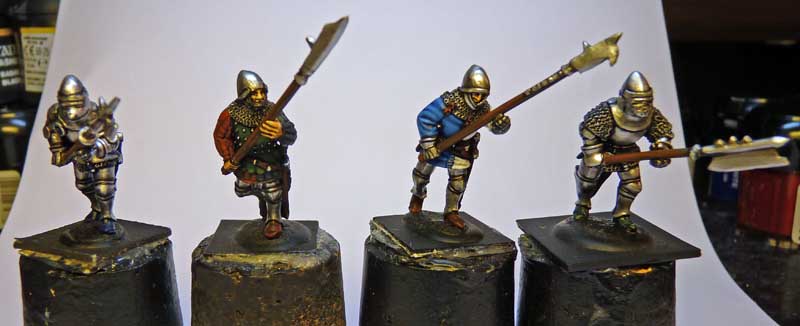
English Men at Arms: Step by Step I:

Having not managed to make a post in over a week and finding myself painting a few men at arms I decided to do a quick step by step of how I have painted the more generic men at arms/knights. These will go towards making up the final base for Bedford's battle


As you can see above we have four Perry Miniatures knights in the early stages of painting. Basically what we have before us is the figures cleaned up, given a dusting of black spray undercoat. This is then followed up with a 50/50 coat of Vallejo Matt Black and water. Into this I mix a small amount of Matt Acrylic Medium to give an excellent flat surface which nicely elucidates the detail on the miniature.

The next stage is to drybrush the mail and add a wash to the flesh. Any 'medium' flesh colour will do for a base- you will no doubt have your own preference. The flesh is given a couple of washes of Citadel Devlan Mud ready for highlighting later on. As for the drybrushing the mail, I start with a darkened mix of GW's Boltgun Metal (90% boltgun/10% Valejo Black) then progress to GW Chainmail then GW Mithril Silver. over the years I have found that the GW metallics are about the best in terms of quality. On the 'lesser men at arms' I then add a diluted wash of Citadel Badab Black over the mail. This helps indicate their status as the riguers of campaign and the lack of a page to clean up their armour means that they are likely to look quite shabby next to their gentlemanly superiors

The layering over the armour is done in much the same way but instead of drybrushing the paint is applied carefully in layers. It is important to take a look at a few suits of full harness before applying these layers. I have a collection of photo's that I've taken at various exhibitions and re-enactments but there is plenty available on the internet if you are stuck. Oddly enough the thing to do to get the impression of light bouncing off the surfaces of the armours is not to attempt to copy it direct from the pics. Instead try to create a general impression of what you see on your source material. This in my opinion gives the best results.

It is essential that the undercoat/earlier preperation is left showing through the different pieces of the plate. If you make a mistake, don't fret, you can easily rectify this by blacklining or in the case of the figures we are painting, just add some Vallejo Black to some Boltgun Metal and use this to line mistakes.

OK, that's it for now. Next I'll be adding the flesh tones and colour to the clothing and fabric covered armours.

English Men at Arms: Step by Step II:

OK, here's the pic of the men at arms with the armour fully painted. In the time since my last post the PO delivered the Andrea 'Silver' metal set to my door. I have used the lightest colour in their set to add an intermediate hue to the fully harnessed knights. With the 'lesser' man at arms I just stopped at the Andrea highlight and dropped the Mithril Silver- I think that it has had the desired effect in that they are hopefully looking slightly less bling! Note that I have also made a point of going over any areas between the plates where my brush may have strayed, this gives greater definition to the armour and neatens everything up to boot.


Next up will be the painting of the gambeson, the coat of plates and everything else. Should be done in a day or so.

English Men at Arms: Step by Step III:

Ok, so a bit faster then last time, here is the third and final post for the English Men at Arms step by step.


As you can see they are now complete. Final colour selection was not too difficult for the men at arms as they are in full harness and it was really only a matter of choosing what colours to do their respective belts, shoes and scabbards etc. I chose a very dark blue and a very dark green (both from Foundry)- applying the paint in three layers paying attention to follow the contours of their equipment.

That out of the way, this being Bedfords main battle, I decided to keep with the theme of liveried retainers so one was chosen as one of Fastolf's men and the other was to wear the livery of Bedford and the Lancastrian kings.

Fastolf's livery is red and black. I used the Vallejo Dark Rust for the red from one of their Panzer Ace sets and added Vallejo Scarlet to highlight. Having just been delivered of the Black Andreas paint set it seemed the perfect moment to try it out of Falstolf's man. His gambeson was painted Vallejo Black and then highlighted with No's 5 and then 6 from the Andreas Black set. I think that it came out very well and is a very subtle way of highlighting black.

Bedford's man. I started with Foundry Midnight Blue(B) and added progressive layers of Foundry Sky Blue (A) then Vallejo white to the mix. The White being done with the Foundry Arctic Grey set but instead of using their white I use Vallejo Model Colour White as it is both strong and vibrant, all the better for painting up Late Medieval armies.

The leather work was GW Scorched Earth with Black, then Scorched Earth by itself and finally Dark Flesh. Polearms were Scorched Earth with a little Black and a highlight of a medium brown- any will do as long as it's not too light.

Tuesday, 4 February 2020

Bedford's Battle- Battle of Verneuil 1424 (From La Journee Blog)


Here we have Bedfords Battle for the WAB army that accompanied me to Havok! at Gripping Beast HQ, Evesham. The first unit I will be putting together for The Battle of Verneuil demo game will contain many of these miniatures, if not all of them. I think Simon and I have settled upon the idea of using Impetus, with some modifications, as it is probably for the good that we keep the rules simple as we are hoping to be chatting with a few folks as we play the game!

As the unit is based for WAB it gives me an opportunity to talk a little about the composition of the stands and what prompted me to paint up the miniatures in the manner that I have done. As I have said before long the mini's will be based for Impetus..... I'm thinking of 60mm by 60mm bases as this fits with other rule systems like Foundry's Medieval Warfare, and as many Medieval wargamers will know, it is not always easy to find a fellow enthusiast that plays the same rule system as one another. I will be adding another 60x60mm base in order to make the units 180mm wide as this will look much better on the tabletop and will make no difference whatsoever to the way in which the rules operate.


As you can see from the pics above featuring Bedfords stand, his heraldic attire is not in what you might expect from the third son of Henry V and the uncle of Henry VI. As will be explained later, in an indepth introduction leading up to and including the battle, Bedford made a great deal out of Heraldic Pageantry prior to the battle in a dramatic display designed to bring a strength through unity and a sense of purpose to the army. He wore a surcoat combining the white cross of France with the red cross of England in order to convey the message of union between the two kingdoms and that Bedford alone had the right to bear this coat of arms. I have painted him up with the white cross of France quartered with the red cross of England instead of superimposing the images as is suggested in de Waurin's account (you will hear more about this chap later). Bedford is a from Perry miniatures as are most of my collection. The actual mini is taken from their French High command at Agincourt on Foot pack and is the Duc de Orleans figure. His heraldry was beautifully sculpted on to the miniature by Michael Perry which in this case was actually an impediment to getting the effect I wanted! So, I took a Dremel to the heraldry (yep, you heard me! A Dremel) and carefully ground off his coat of arms. This was smoothed down by hand with a needle file before priming.

Next to John of Bedford stands John Talbot, known for his prowess in battle and his daring. There is only one chronicle that indicates his presence at the battle but I have included him as the rest of the 'cast of characters' were present and there is no reason to suppose that such an important figure would not be in amongst the action. Talbot wears his heraldic coat of arms and wields a vicious poleaxe as appropriate.

The musician advancing behind Bedford and Talbot wears the Lancastrian livery of Bedford. Musicians of this type would have had a limited but important role on the battlefield, indicating where the banners were, at what pace to advance etc. It has to be said that once battle was joined they may have become superfluous.


This brings us onto the next base. Sir Henry Tilleman was given the right to bear Bedfords Heraldic banner. Tillemen was over 70 years old and had been active in the Black Prince's expedition to Spain and fought at the Battle of Najera, 1367! Bedford, by honouring Tillemen was making a deliberate link to the past and the Battle of Najera, which recalled the days of the Black Prince as a commander of renown enhancing the martial prowess of his army. Of the two other knights, one wears a surcoat and is evading a blow, perhaps as a feint, wielding his poleaxe. The other advances without bearing his arms as was often the practice of the English at that time.


Next I'll be taking a look at Fastolf and his retainers as pictured in the unit at the top of this page.